What Is the Rice Purity Test? Origin, Questions, and Why It’s Still Popular
The Rice Purity Test is a 100-question self-assessment checklist designed to measure a person’s life experiences. Originally created at Rice University as a bonding activity for incoming students, the test has evolved into a viral internet trend shared widely across social media platforms.
Although often misunderstood as a psychological evaluation, the Rice Purity Test is simply a fun, informal way for people, especially students, to compare experiences and spark conversation. In this complete guide, we’ll explore its origin, how it works, sample questions, scoring meaning, and why it remains popular even in 2026.
What Is the Rice Purity Test?
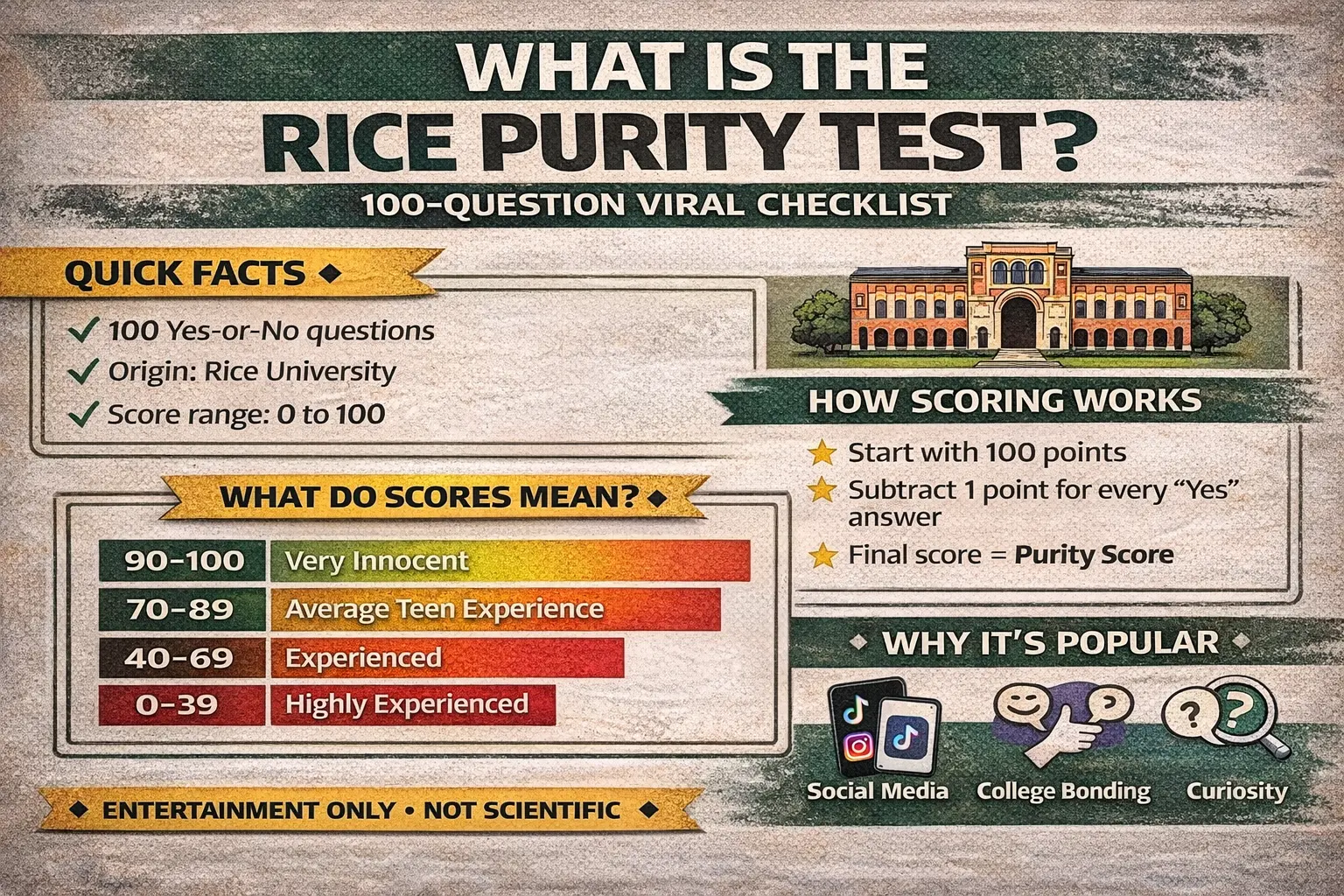
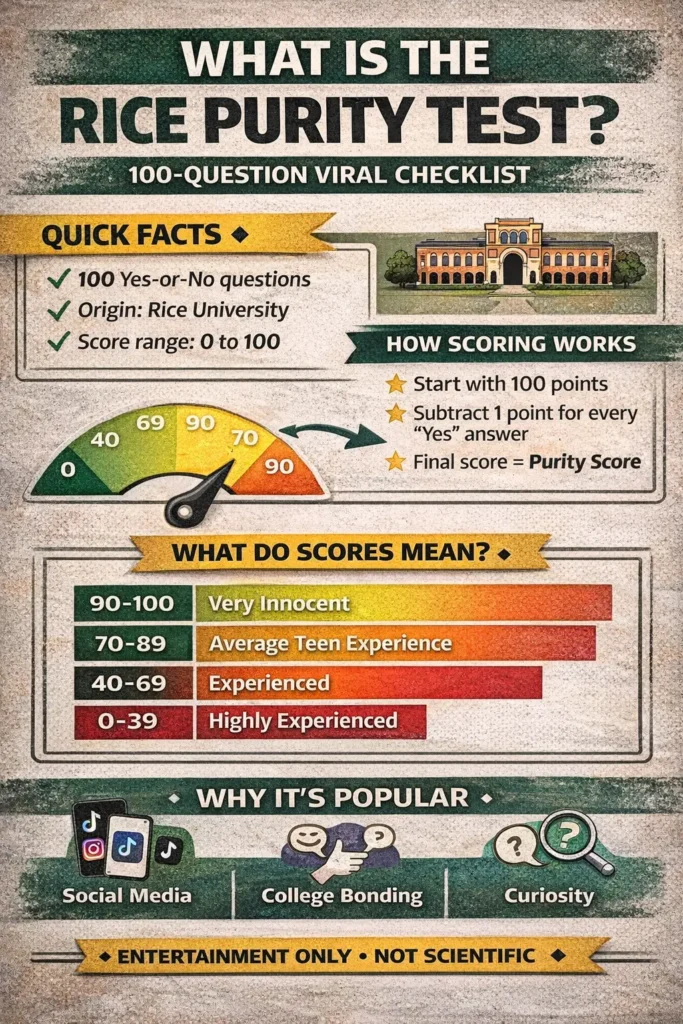
The Rice Purity Test is a 100-item yes-or-no questionnaire. Participants start with a score of 100 and subtract one point for every “yes” answer. The final number represents their “purity score.”
How Scoring Works
- Start at 100 points.
- Subtract 1 point for every experience completed.
- Final score ranges from 0 to 100.
What Do Scores Mean?
| Score Range | Interpretation |
|---|---|
| 90–100 | Very innocent |
| 70–89 | Moderately experienced |
| 40–69 | Socially experienced |
| 0–39 | Highly experienced |
Important: The test is not scientific and does not measure morality or character.
Origin of the Rice Purity Test
The Rice Purity Test originated at Rice University in Houston, Texas.
Original Purpose
- Created as an orientation icebreaker.
- Helped new students bond.
- Encouraged open discussions.
- Built dorm community connections.
In the early versions, the test was shared among students on paper. Over time, it spread online and became widely accessible. Getting Information another Fashion Why Disco Cowboy Hats Are Trending: Shop the Best Styles Online?
By the 2010s, it had become a viral internet phenomenon.
How the Rice Purity Test Works?
The structure is simple and consistent.
100 Yes-or-No Questions
The test covers areas such as:
- School experiences.
- Relationships.
- Social activities.
- Personal milestones.
- Rule-breaking behaviors.
It gradually progresses from mild experiences to more personal or adult-related questions.
Sample Rice Purity Test Questions
To understand its tone, here are general examples (safe for all readers):
- Have you ever held hands with someone?
- Have you ever skipped class?
- Have you ever been on a date?
- Have you ever lied to your parents?
- Have you ever broken a school rule?
The actual test includes broader lifestyle and relationship questions, but the core idea remains consistent.
Why Is the Rice Purity Test Still Popular in 2026?
Despite being decades old, the test remains relevant. Here’s why:
1️⃣ Social Media Sharing
Platforms like TikTok, Instagram, and Snapchat helped revive interest.
Users often:
- Share their scores publicly.
- Compare with friends.
- Turn it into challenges.
The competitive and humorous aspect keeps it trending.
2️⃣ College Culture
Universities continue using it informally as:
- Dorm icebreaker activity.
- Freshman bonding exercise.
- Group conversation starter.
It creates an easy way to connect without serious pressure.
3️⃣ Curiosity & Self-Reflection
People enjoy seeing how their experiences compare with peers. It offers:
- Light self-reflection.
- A sense of progression.
- Social comparison.
Even adults sometimes revisit it out of curiosity.
4️⃣ Internet Virality
Because the test is:
- Simple.
- Easy to complete.
- Shareable.
- Emotionally engaging.
It continues circulating online.
Is the Rice Purity Test Accurate or Scientific?
Short answer: No.
It is:
- Not a psychological evaluation.
- Not medically validated.
- Not linked to moral value.
- Not a diagnostic tool.
It was created purely for fun and community bonding.
Users should treat it as entertainment, not as a measure of personal worth.
Privacy & Safety Considerations
Before taking the test online:
- Avoid sharing personal data.
- Use reputable websites.
- Don’t post sensitive details.
- Remember your score is private.
Some unofficial sites may collect data, so caution is important.
Common Misconceptions
❌ Myth: Lower score means “bad person”
Reality: It only means more life experiences.
❌ Myth: It measures morality
Reality: It measures self-reported experiences only.
❌ Myth: It is official university testing
Reality: It started at Rice University but is now unofficial online.
Frequently Asked Questions
Q1. What is a good Rice Purity Test score?
Ans. There is no “good” or “bad” score. Higher scores indicate fewer experiences, while lower scores reflect more experiences.
Q2. Is the Rice Purity Test only for college students?
Ans. No. Anyone can take it, though it is most popular among teenagers and college students.
Q3. Is the Rice Purity Test safe?
Ans. It is safe if taken on reputable websites and if you avoid sharing personal data publicly.
Q4. Can adults take the Rice Purity Test?
Ans. Yes. Many adults take it for nostalgia or curiosity.
Final Thoughts
The Rice Purity Test began as a simple college bonding activity but has grown into a viral internet tradition. Its continued popularity in 2026 proves that people enjoy lighthearted self-reflection and social comparison.
While it is not scientific, it remains an entertaining way to spark conversation, laugh with friends, and explore life experiences.